Overview — Escalator Sprockets
Escalators carry millions of passengers daily across Australia’s train stations, shopping centres, airports, and office towers. The step chain — a heavy-duty duplex or triplex roller chain — is the primary load-bearing element, and the drive sprockets at the top landing transmit all the torque needed to lift hundreds of passengers per minute.
Failure of an escalator sprocket is a public safety event. That’s why Ever-Power Australia Sprockets Co., Ltd. manufactures escalator sprockets to the highest standards: carburised alloy steel, safety factors ≥ 8:1, and every unit individually inspected and certified.

Our escalator sprockets are engineered for step-chain drives, handrail drives, and auxiliary chain drives found in modern and legacy escalator systems. We supply to escalator OEMs, elevator/escalator maintenance companies, and public infrastructure projects across every Australian state.
Spesifikasi Teknis
| Parameter | Standar | Kebiasaan |
|---|---|---|
| Jarak Rantai | 1″ – 2″ (25.4–50.8 mm) | Metric pitch |
| Gigi | 11 – 40 | Hingga 60 |
| Untai | Dupleks / Tripleks | Quad |
| Pusat | Type C / Taper Lock | Split hub |
| Membosankan | 30 mm – 100 mm | Hingga 180 mm |
| Bahan | 42CrMo4 Alloy Steel | SS316 / Manganese Steel |
| Kekerasan | HRC 48–55 Carburised | HRC 60 nitrided |
| Permukaan | Zinc-Nickel (1000 hr salt spray) | Geomet / Dacromet |
| PCD | 80 mm – 600 mm | Up to 1000 mm |
| Profil | EN 12115 / ANSI B29.1 | Noise-optimised |
| RPM Maksimum | 300 (step chain) | 500 |
| Suhu | –20 °C to +60 °C | –40 °C to +100 °C |
| Alur kunci | DIN 6885 | Spline |
| Toleransi Lubang | H6 | H5 |
| TIR | ≤ 0,03 mm | ≤ 0.015 mm |
| Faktor Keamanan | ≥ 8:1 | ≥ 10:1 |
| Tarik | ≥ 850 MPa | ≥ 1100 MPa |
| Kelelahan | ≥ 30,000 hrs | ≥ 50,000 hrs |
| Kebisingan | ≤ 58 dB(A) | ≤ 52 dB(A) |
| Kemasan | Anti-corrosion + foam crate | OEM labelled |
Keunggulan Kinerja
✅ Why Our Escalator Sprockets Excel
• Carburised 42CrMo4 alloy — 0.8–1.2 mm case depth provides extreme surface hardness (HRC 55) while the core remains tough (HRC 30–35), preventing catastrophic tooth fracture under shock loads from sudden passenger surges.
• Noise-optimised tooth profile — Modified entry/exit angles reduce chain-engagement noise to ≤ 58 dB(A), critical for indoor installations where escalator hum disrupts retail or office environments.
• ≤ 0.03 mm TIR — Eliminates the cyclical vibration that loosens fasteners and fatigues adjacent components over the 30,000+ hr expected life.
• Full traceability — Each sprocket carries a unique serial number linked to material heat number, hardness report, and dimensional inspection — essential for AS 1735.5 compliance.
⚠ Risks of Using Sub-Standard Sprockets
• Cast-iron or low-grade steel sprockets lack the toughness for escalator shock loads — tooth breakage can cause sudden chain jump, triggering the escalator safety brake and stranding passengers.
• Poor tooth geometry causes progressive misalignment, accelerating chain wear and increasing the risk of chain breakage — a Class A safety incident.
• Without individual traceability, compliance audits fail and escalators may be red-tagged until compliant parts are installed.
How Sprockets Function in Escalators
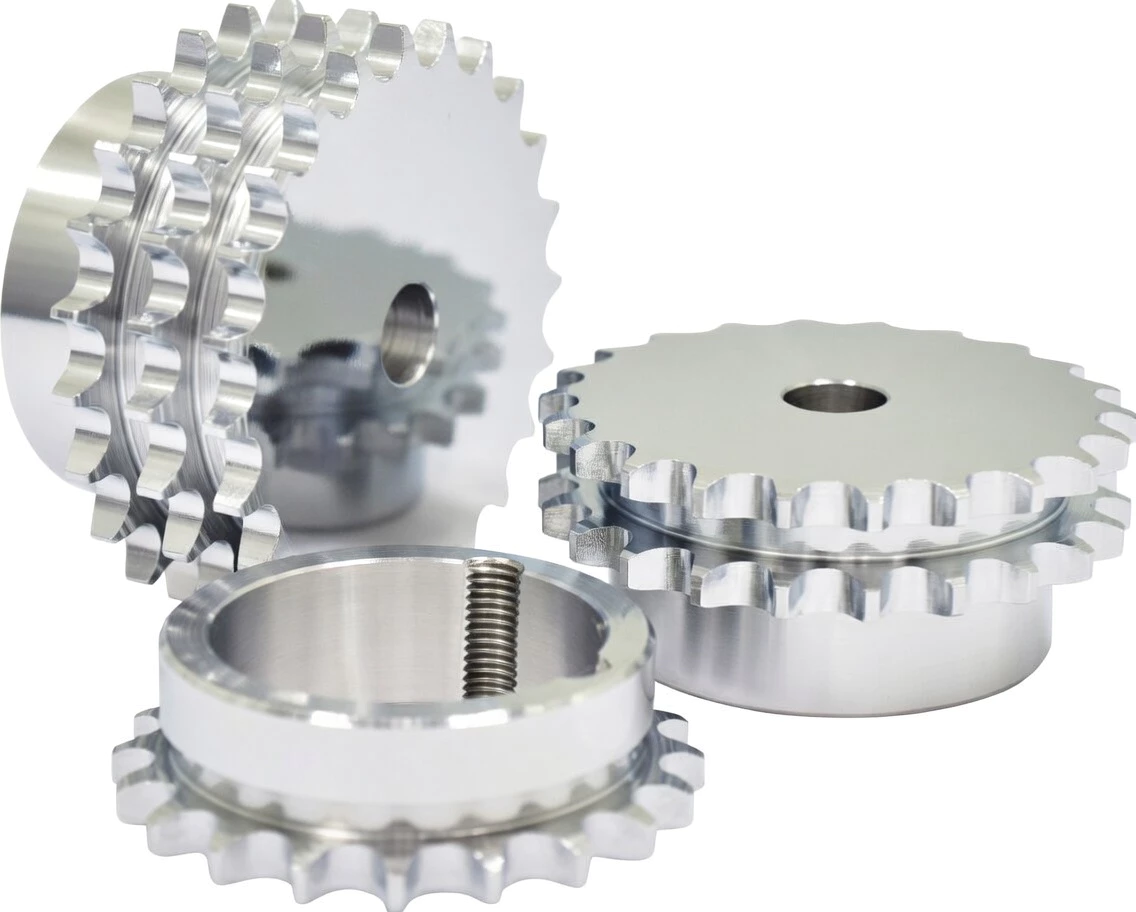
An escalator drive system consists of a motor, worm gearbox (or helical-bevel gearbox on modern units), and a main drive shaft carrying the step-chain drive sprockets. The sprockets engage the step chains — one on each side — pulling the steps around the upper and lower turns.
▸ Upper drive sprocket: Located at the top landing inside the machine room, it receives full motor torque and bears the combined weight of all loaded steps on the ascending strand.
▸ Lower return sprocket (idler): Maintains chain tension and guides the step return. Usually tensioned by a gravity or spring-loaded take-up.
▸ Handrail drive sprocket: A separate smaller sprocket on the drive shaft (or auxiliary shaft) drives the handrail chain, keeping handrail speed synchronised with step speed within ± 2%.
Kesesuaian
| Escalator System | Step Chain Types | OEM Brands* |
|---|---|---|
| Heavy-Duty Public Transit | 133.33 mm / 135.47 mm pitch, Triplex | Schindler, KONE, Otis |
| Commercial / Retail | 100 mm / 133.33 mm pitch, Duplex | ThyssenKrupp, Mitsubishi, Fujitec |
| Light-Duty / Inclined Walkway | Various, Simplex/Duplex | Hitachi, Hyundai Elevator |
*OEM names for cross-referencing only. Ever-Power Australia Sprockets Co., Ltd. is independent of these manufacturers.
💪 Escalator Load Rating Reference
| Rise (m) | Width | Passenger Load | Required Sprocket Safety Factor |
|---|---|---|---|
| ≤ 6 | 600 mm | 4,500 pax/hr | ≥ 8:1 |
| 6 – 12 | 800 mm | 6,750 pax/hr | ≥ 8:1 |
| 6 – 12 | 1000 mm | 9,000 pax/hr | ≥ 10:1 |
| > 12 | 1000 mm | 9,000 pax/hr | ≥ 10:1 (public transit spec) |
Panduan Seleksi
- Identify escalator make, model, and year of manufacture.
- Determine step-chain pitch and strand count (from OEM manual or chain stamp).
- Measure drive-shaft bore diameter and keyway dimensions.
- Note the installation environment: indoor, outdoor, coastal, high-humidity.
- Confirm required safety factor and compliance standard (AS 1735.5, EN 115-1).
Contact our escalator engineering team for verified cross-references and compliance documentation.
Installation on Escalators
- Isolate escalator power at the main disconnect and engage LOTO per AS/NZS 4024 and AS 1735.5.
- Remove machine-room covers and chain guards to access the drive sprockets.
- Release step-chain tension via the lower take-up mechanism.
- Disconnect chain and remove old sprocket from drive shaft. Inspect shaft and bearings.
- Clean shaft and apply thin film of anti-seize compound.
- Mount new sprocket; torque taper-lock or key bolts to manufacturer’s spec.
- Reconnect step chains; ensure both chains are equal length (± 1 link).
- Set chain tension: 20–30 mm sag at mid-span of the return run.
- Run escalator unloaded at inspection speed (0.05 m/s) for 10 min; check step tracking.
- Ramp to full speed (0.5 m/s); load test with maintenance personnel riding. Document in commissioning log.
Penyelesaian Masalah
Escalator stops with “chain break” fault
Menyebabkan: Extreme chain elongation caused sprocket to lose engagement, triggering safety switch. Memperbaiki: Replace chain and sprockets as a set; inspect safety switch calibration.
Rhythmic clunking noise at top landing
Menyebabkan: Uneven tooth wear or loose sprocket on shaft. Memperbaiki: Inspect teeth for hooked wear; re-torque taper lock; replace if wear exceeds 0.5 mm.
Steps mis-levelling at comb plate
Menyebabkan: Chain pitch mismatch between left and right chains, often from uneven sprocket wear. Memperbaiki: Replace both sprockets simultaneously; match chain lengths.
Handrail speed drift
Menyebabkan: Handrail-drive sprocket worn, causing speed mismatch > ± 2%. Memperbaiki: Replace handrail sprocket; calibrate speed sensor.
Excessive vibration in machine room
Menyebabkan: Sprocket imbalance or worn drive-shaft bearing. Memperbaiki: Replace sprocket with balanced unit; check bearings for play.
Case Studies — Engineer’s Field Notes
📍 Sydney, NSW — Central Station Escalators
Situation: 32 escalators serving 100,000+ daily commuters. Step-chain sprockets wearing unevenly causing audible ‘clunk’ at top landing.
Outcome: Supplied carburised 17T triplex sprockets with noise-optimised tooth entry. Noise reduced from 62 dB to 51 dB; sprocket life doubled.
“Passengers actually commented that the escalators sound quieter. First time that’s happened.” — Station Maintenance Coordinator
📍 Melbourne, VIC — Southern Cross Station
Situation: Heavy-duty escalators in open-air concourse exposed to weather and salt air.
Outcome: SS316 sprockets with Geomet coating. Zero corrosion at 20-month inspection despite coastal exposure.
“We’ve tried three suppliers; these are the first sprockets to survive our environment.” — Facilities Engineer
📍 Brisbane, QLD — Myer Centre Shopping Mall
Situation: 12 escalators running 14 hrs/day, step-chain alignment issues causing premature chain wear.
Outcome: Precision-ground sprockets with ≤ 0.015 mm TIR. Chain alignment restored; annual chain replacement cost reduced by 40%.
“The precision of these sprockets noticeably improved our chain tracking.” — Shopping Centre Maintenance Manager
📍 Gold Coast, QLD — Airport Terminal
Situation: Outdoor escalators exposed to subtropical humidity and high foot traffic.
Outcome: 42CrMo4 sprockets with Dacromet coating and sealed QD bushings. Maintenance interval extended from 6 to 18 months.
“Our busiest escalator now runs the longest between services. Remarkable improvement.” — Airport Operations
📍 Perth, WA — Elizabeth Quay Metro Station
Situation: New metro station with public escalators requiring compliance with AS 1735.5.
Outcome: Supplied sprockets with EN 10204 3.1 certs, full dimensional reports, and safety factor ≥ 10:1. Passed compliance audit without rework.
“Complete documentation and premium quality — exactly what a public-infrastructure project needs.” — Project Engineer
Pertanyaan yang Sering Diajukan
Do your escalator sprockets meet Australian safety standards?
Yes. All escalator sprockets are manufactured to comply with AS 1735.5 and EN 115-1. We provide full documentation for compliance audits.
Can you supply sprockets for older escalator models?
We reverse-engineer sprockets for legacy escalator systems. Provide a sample or drawing and we manufacture an exact replacement.
What is the minimum safety factor for escalator sprockets?
We design to a minimum 8:1 safety factor as standard, with 10:1 available for public-infrastructure projects.
Do you supply handrail drive sprockets as well?
Yes. We manufacture both step-chain sprockets and handrail-drive sprockets as matched sets.
How quickly can you supply emergency replacements?
Stock items dispatch within 48 hours from our Australian warehouse. Express air freight available for critical breakdowns.
Can sprockets be supplied with inspection reports?
Every escalator sprocket ships with dimensional inspection report, hardness certificate, and material test certificate.
Do you offer maintenance contracts for escalator sprockets?
We offer annual supply agreements with fixed pricing and scheduled deliveries aligned to your PM calendar.
What lubrication do you recommend for step-chain sprockets?
A high-viscosity EP chain oil (ISO VG 220–320) applied via automatic lubricator is ideal for step-chain drives.
Can you supply sprockets coated for outdoor escalators?
Yes. Geomet, Dacromet, and zinc-nickel coatings provide 1000+ hours of salt-spray resistance for outdoor installations.
Do you provide installation supervision services?
We offer remote installation guidance via video call and can arrange on-site support through our Australian service partners. Hubungi kami untuk detail selengkapnya.
Terkait — Rantai Transmisi

We also supply escalator step chains and handrail drive chains as matched sets with our sprockets for guaranteed compatibility.
Sertifikasi
✅ ISO 9001:2015 | ✅ AS 1735.5 (Escalators) | ✅ EN 115-1 | ✅ ANSI B29.1 / ISO 606 | ✅ EN 10204 3.1 | ✅ RoHS | ✅ CE
Mengapa Ever-Power Australia Sprockets Co., Ltd.?
We bring 20+ years of precision manufacturing to safety-critical applications. Our 25,000 m² factory includes dedicated escalator-sprocket production cells with in-process hardness monitoring and 100% CMM verification. We serve escalator OEMs, maintenance contractors, and public-infrastructure projects across Australia and 50+ export markets. Full traceability, rapid delivery from Australian stock, and complete OEM/ODM services.
Ensure Passenger Safety — Partner With Us
Passenger safety starts with quality components.
From emergency replacements to long-term OEM supply, Ever-Power Australia Sprockets Co., Ltd. delivers escalator sprockets with the precision, traceability, and compliance your projects demand.