Overview — Sprockets for Filling Lines

Australia’s food and beverage sector — from dairy processors in Victoria to craft breweries in Tasmania and juice bottlers in Queensland — relies on high-speed filling lines that must run cleanly, accurately, and continuously. The sprockets driving bottle conveyors, capping stations, and labelling indexers operate in washdown environments with caustic chemicals, steam CIP cycles, and strict hygiene mandates.
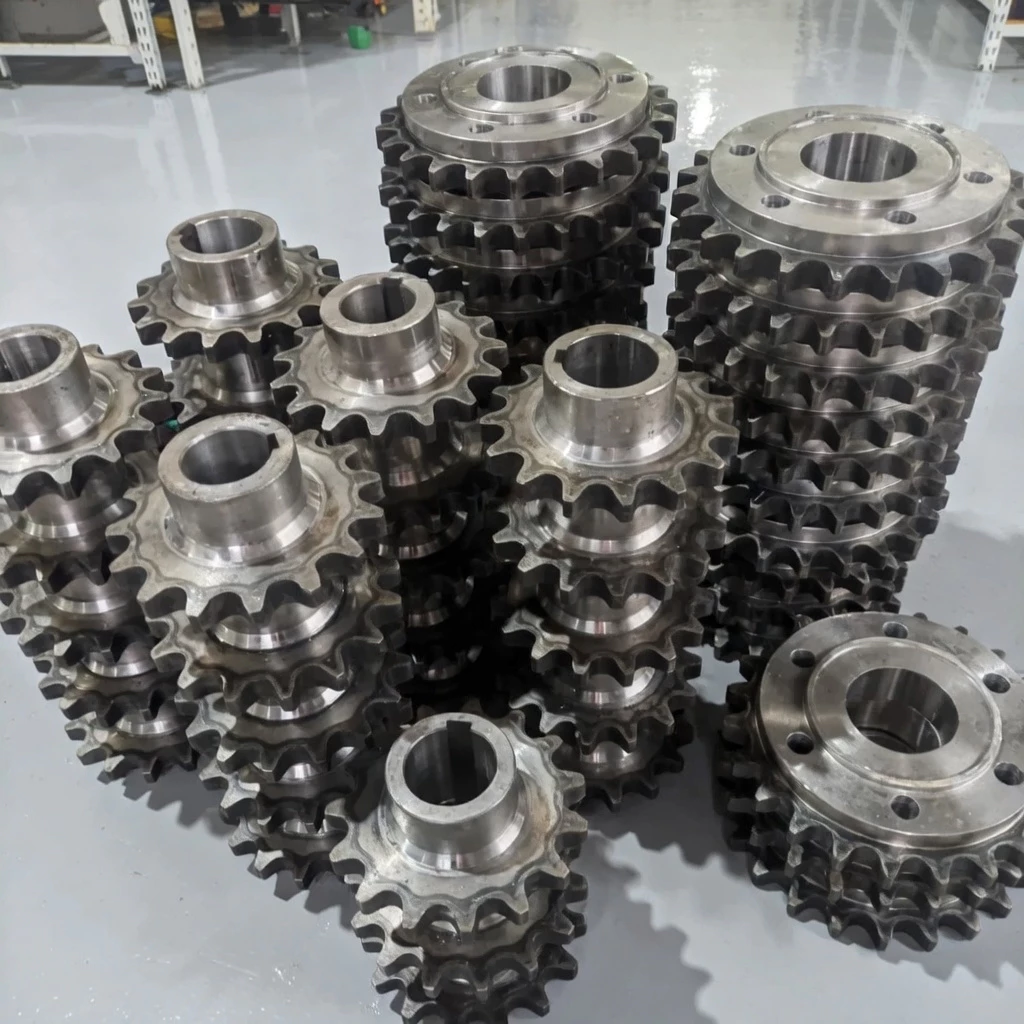
Ever-Power Australia Sprockets Co., Ltd. manufactures food-grade filling-line sprockets in SS 304, 316, and 316L, electropolished to ≤ 0.8 µm Ra and compliant with FDA 21 CFR and 3-A sanitary standards. Our sprockets keep your line moving at rated speed while passing the toughest food-safety audits.
Technical Specifications
| Parameter | Standard | Custom |
|---|---|---|
| Chain Pitch | 3/8″ – 1″ (ANSI 35–80) | Up to 1-1/2″ |
| Teeth | 9 – 45 | Up to 72 |
| Strand | Simplex / Duplex | Triplex |
| Hub | Type A / B / QD / Taper | Stainless flanged |
| Bore | 10 mm – 60 mm | Up to 100 mm |
| Material | SS 304 / SS 316 | SS 316L / Duplex 2205 |
| Hardness | HRC 28–38 (SS) | HRC 45 precipitation-hardened |
| Surface | Electropolished / Passivated | Mirror Ra ≤ 0.4 µm |
| PCD | 35 mm – 450 mm | Up to 700 mm |
| Profile | ANSI B29.1 / ISO 606 | FDA / 3-A compliant modified |
| Max RPM | 1,200 | 2,000 |
| Temp | –20 °C to +120 °C | –40 °C to +200 °C (steam CIP) |
| Keyway | DIN 6885 | Hex / D-bore / Spline |
| Bore Tolerance | H7 | H6 |
| TIR | ≤ 0.05 mm | ≤ 0.02 mm |
| Lubrication | H1 food-grade | Dry-running (self-lubricating bush) |
| Tensile | ≥ 520 MPa (304) | ≥ 690 MPa (duplex) |
| Fatigue | ≥ 10,000 hrs | ≥ 22,000 hrs |
| Corrosion | 300 hr salt spray (304) | 1500 hr (316L) |
| Packaging | Cleanroom poly bag | Vacuum-sealed + CoC |
Performance Advantages
Audit-Ready Hygiene
Electropolished stainless steel with no crevices or exposed fasteners. Passes BRC, SQF, and HACCP audits without modification.
CIP / Washdown Proof
Withstands daily caustic and acid wash cycles, 85 °C steam CIP, and high-pressure hosing without pitting, staining, or dimensional change.
Zero Unplanned Stops
Precipitation-hardened teeth resist the wear that causes chain slip on high-speed fillers — maintaining ±0.5 mm indexing accuracy over 20,000+ hours.
Inferior alternatives: Carbon-steel sprockets rust within weeks in washdown zones, contaminating product and failing audits. Chrome-plated versions flake under CIP chemicals, creating foreign-body risks. Only solid stainless delivers safe, long-term performance.
How Sprockets Work in Filling Lines
Modern filling lines use chain-and-sprocket drives in several critical stations:
▸ Bottle/can conveyor drive: Table-top or side-flex chains driven by stainless sprockets transport containers from rinser to filler to capper at speeds up to 1,200 BPM (bottles per minute). Precise sprocket tooth geometry ensures smooth container flow without jams.
▸ Filler turret indexing: A precision sprocket synchronises the turret rotation with container feed. Even 0.2 mm tooth wear causes fill-level variation and product giveaway.
▸ Capping head drive: Sprockets drive the chuck or snap-cap mechanism. Consistent torque delivery is essential for seal integrity.
▸ Labeller timing: The label applicator’s sprocket must index exactly to the container position. Worn teeth cause label skew and rework.
▸ Accumulation table: Mass-flow accumulation tables use multiple sprocket-driven chains to buffer containers between filler and packer.

Compatibility
| Station | Chain Types | Equipment* |
|---|---|---|
| Bottle Conveyor | Table-top SS, Side-flex | Sidel, KHS, Krones |
| Filler Turret | ANSI 40–60 SS | GEA, Tetra Pak, CFT |
| Capping Station | ANSI 35–50 SS | Arol, Zalkin, Pacific Packaging |
| Labeller | ANSI 35–40 SS, Timing chain | Krones, P.E. Labellers |
*Brand names for cross-referencing only. No affiliation.
📊 Line Speed vs Sprocket Inspection Interval
| Line Speed (BPM) | Product Type | Inspect (Budget SS) | Inspect (Ever-Power SS) |
|---|---|---|---|
| 200–400 | Juice / Dairy | Every 3 months | Every 12 months |
| 400–800 | Soft drink / Beer | Every 6 weeks | Every 8 months |
| 800–1,200 | Water / Energy drink | Every 3 weeks | Every 5 months |
Selection Guide
- Identify chain type (table-top, roller, side-flex) and pitch from the line OEM manual.
- Determine line speed (BPM) and operating hours per day.
- Specify stainless grade: SS 304 for dry areas; SS 316/316L for high-acid or CIP zones.
- Measure bore and hub type. Food lines often use smooth (keyless) bores with set screws to eliminate crevices.
- Confirm surface finish requirement: standard passivated (Ra ≤ 0.8 µm) or mirror electropolished (Ra ≤ 0.4 µm) for dairy/pharma.
Contact our food-industry sprocket team for material certificates and 3-A compliance documentation.
Installation
- Isolate and lockout filler line per HACCP and AS/NZS 4024.
- Remove chain guard covers and release chain tension.
- Break chain and remove old sprocket. Use SS tools to avoid carbon-steel contamination.
- Clean shaft with food-grade solvent; inspect for scoring.
- Fit new sprocket; use food-grade anti-seize on set screws.
- Re-route chain and connect with SS master link.
- Adjust tension per OEM spec (typically 5–10 mm deflection per 300 mm).
- Lubricate with H1 food-grade chain lube only.
- Replace all guards. Run at slow speed; verify smooth tracking.
- Conduct a CIP cycle before resuming production to flush any installation debris.
Troubleshooting
Bottle jams at transfer star
Cause: Worn sprocket teeth causing timing drift between conveyor and star wheel. Fix: Replace sprocket; re-time star wheel.
Fill level inconsistency
Cause: Filler turret sprocket wear causing ±1–2 mm positional error. Fix: Replace turret drive sprocket; recalibrate filler.
Rust staining on conveyor
Cause: Carbon-steel sprocket or fasteners in washdown zone. Fix: Replace all carbon-steel components with SS 316; use SS fasteners throughout.
Chain elongation after CIP
Cause: Caustic CIP solution attacking non-stainless chain pins. Fix: Upgrade to full-stainless chain; match with SS sprocket.
Excessive noise at high speed
Cause: Sprocket/chain pitch mismatch or worn teeth. Fix: Verify pitch compatibility; replace sprocket if tooth wear > 0.3 mm.
Case Studies
📍 Laverton, VIC — Dairy Processor
UHT milk filling line, 600 BPM, daily caustic CIP. Carbon-steel sprockets rusting within 4 weeks.
Result: SS 316L electropolished sprockets. 14 months in service, zero rust, passed 3 consecutive BRC audits.
“Rust contamination was our #1 audit non-conformance. It’s gone now.” — QA Manager
📍 Hobart, TAS — Craft Brewery
Can filling line, 400 BPM, acidic beer residue. Sprocket teeth wearing after 8 weeks.
Result: Precipitation-hardened SS 17-4PH sprocket. 11 months service life — 6× improvement.
“We stopped losing production to worn sprockets. Huge win for a small brewery.” — Head Brewer
📍 Mundingburra, QLD — Juice Bottler
Tropical fruit juice line, 800 BPM, high sugar and acid content causing chain and sprocket corrosion.
Result: SS 316 sprockets with mirror electropolish. Sugar residue no longer adheres; cleaning time reduced 40%.
“The smooth finish means less cleaning and less biofilm risk. Our HACCP team loves it.” — Plant Manager
📍 Adelaide, SA — Wine Bottling
Glass bottle filling line, 300 BPM. Capping station sprocket causing inconsistent torque.
Result: Precision-ground SS 304 capping sprocket (TIR ≤ 0.02 mm). Cap torque variation reduced from ±15% to ±3%.
“Consistent caps mean fewer returns from retailers. Worth every cent.” — Winemaker
📍 Smithfield, NSW — Pet Food Canning
Wet pet food canning line, 500 BPM, aggressive retort steam. Sprockets pitting after 6 months.
Result: Duplex 2205 stainless sprockets rated for 200 °C steam. 18 months in service, zero pitting.
“Duplex stainless was the breakthrough. Standard 316 couldn’t handle our retort process.” — Maintenance Engineer
Frequently Asked Questions
Are your sprockets FDA and 3-A compliant?
Yes. Our food-grade SS sprockets are manufactured from FDA 21 CFR 177.2600 compliant materials and are available with 3-A sanitary certification upon request.
What surface finish do you recommend for dairy lines?
Mirror electropolished to Ra ≤ 0.4 µm for dairy and pharmaceutical applications. Standard passivated (Ra ≤ 0.8 µm) is suitable for most beverage lines.
Can you supply sprockets for table-top conveyor chains?
Yes. We manufacture drive and idler sprockets for all major table-top chain profiles including Rexnord, Intralox, and Uni-Chain.
Do you provide material certificates?
Yes. EN 10204 3.1 mill certificates and full traceability documentation are included with every food-grade order.
What is the lead time for SS 316L sprockets?
Stock sizes ship within 3–5 business days. Custom sizes typically 2–3 weeks.
Can I use H1 food-grade lubricant on your sprockets?
Absolutely. Our sprockets are compatible with all H1-rated lubricants. We also offer self-lubricating bushed sprockets for lube-free zones.
Do you supply to food-plant EPCM contractors?
Yes. We work with major food-plant builders and can supply to project specifications and delivery schedules.
What is the price difference between SS 304 and SS 316L?
SS 316L is typically 20–30% more than SS 304. The investment is justified in high-acid, high-CIP environments where 304 would pit prematurely.
Can you match an OEM filler sprocket from a sample?
Yes. Send us the worn sprocket or a drawing and we’ll reverse-engineer an exact replacement.
Do you offer scheduled replacement programs?
Yes. We offer planned-maintenance sprocket kits based on your line speed and CIP frequency. Contact us for a maintenance plan.
Related — Stainless Chains

Pair with our stainless-steel roller chains — SS 304/316, passivated, suitable for CIP and washdown environments.
Certifications
✅ ISO 9001:2015 | ✅ FDA 21 CFR | ✅ 3-A Sanitary | ✅ ANSI B29.1 / ISO 606 | ✅ EN 10204 3.1 | ✅ RoHS | ✅ CE
Why Ever-Power Australia Sprockets Co., Ltd.?
We have been manufacturing food-grade and industrial sprockets for over 20 years. Our dedicated stainless-steel production line serves dairy, beverage, brewery, confectionery, and pharmaceutical clients across Australia and 50+ countries. From electropolished micro-sprockets to large turret drives, we deliver the hygiene, precision, and durability that food-safety demands.
Keep Your Line Filling — Contact Us
Food safety starts with the right components.
Ever-Power Australia Sprockets Co., Ltd. supplies audit-ready, food-grade sprockets that keep your filling line running at full speed. Contact us for material certificates and a competitive quote.